Showing posts with label Renault. Show all posts

Monday, February 8, 2010

Renault New Mégane Coupé-Cabriolet

The official images and information released by Renault for the New Mégane Coupé-Cabriolet. The model will debut at Geneva and will feature a large foldable black glass roof and satin chrome trims. The launch is expected for next spring.
The roof has a high-gloss black glass finish which contrasts with contrasts with the satin-effect chrome windscreen frame. The fully-automatic, electro-hydraulic opening mechanism of the two-part roof enables the driver to lower the top in just 21 seconds.
The interior layout is available with three choices of trim, which range from dark charcoal and light beige to the charcoal and red two-tone finish with leather seats.
The torsional rigidity of the bodyshell has been uprated by 80 per cent compared with Mégane II Coupé-Cabriolet in order to match the increased stiffness of the suspension and even greater handling precision.
The extensive range of equipment will include tire pressure monitoring system, directional bi-Xenon headlamps with cornering dipped beams, automatic headlamp activation, automatic windscreen wiper activation, cruise control with speed limiter. Electronic driving adis will inclide ABS with electronic brakeforce distribution, Emergency brake assist and ESC with understeer control.
(Car Body Design's news)

Tuesday, February 2, 2010

Renault Wind preview

At the 2010 Geneva Motor Show Renault will introduce Wind, a new 2-seater coupé-roadster characterized by compact dimensions - under 4 meters in length - and a new electric roof that opens in just 12 seconds and allows for a standard luggage capacity.
(Car Body Design's news)

Thursday, October 8, 2009

Renault Kangoo Z.E. Concept

Unveiled at the 2009 Franfurt Motor Show, the Kangoo Z.E. Concept presents Renault's vision for a future electric vehicle targeted to urban environments and focused on minimizing energy consumption while offering good levels of comfort and practicality.
It is powered by a 70kW electric motor which delivers 226Nm of torque, in conjunction with a lithium-ion battery.
The car range is 160 km, while the top speed is electronically limited to 130 km/h.
Energy consumption is minimized thanks to many energy optimization solutions, such as the advanced climate control system, aerodynamic design, heat-reflective paint, thermal insulation panels.
The battery recharging operation can be operated in two ways: a standard charge takes between four and eight hours, via a charging socket situated on the outside of the vehicle, while a quick charge takes just 20 minutes and uses the same socket at bespoke charge stations.
The conventional drag-producing exterior mirrors have been replaced by streamlined, low-energy cameras which are powered by the roof-mounted solar panels.
These cameras provide improved all- round visibility, which is especially practical when manoeuvring. The full-disc aluminium alloy wheels produce less drag, too, while the headlights use light-emitting diodes (LEDs) which are not only long- lasting but also low consumers of energy.
A linear display on the outside of the door provides an indication of how much range remains even before the driver gets inside the vehicle. This lit display can be likened to the charge indicator of a cell phone.
The use of heat-reflective paint and bodywork featuring large surface areas reduces temperature fluctuations.
Indeed, the bodywork functions along the same lines as a Thermos flask and comprises two insulating panels with a sandwich of air in between.
Thermal insulation is further optimized thanks to specialtreatment of the glazed surfaces, meaning that less call is made of the climate control and heating systems which are big consumers of energy.
Solar panels positioned on the roof are employed to power a temperature regulation system inside the car. Keeping the cabin cool uses a significant amount of energy, but this system also permits a pleasant temperature to be maintained inside the cabin, even at a standstill or when parking, and avoids having to put the climate control system on boost when first getting in the car on a hot day.

(Car Body Design's news)

Tuesday, September 29, 2009

Renault Twizy Z.E. Concept


The Renault Twizy Z.E. Concept is an all-electric compact vehicle which features a width of just 1.1 meters, faired wheels and two seats located one behind the other. It previews the brand's future electric models that will be intrododuced from 2011.
The wraparound bodywork creates a reassuring cocoon and the futuristic cabin can accomodate the driver and one passenger, positioned one behind the other.
The agility is maximized by the low weight (420kg), low centre of gravity and the ultra compact dimensions (2.30m in length, and just 1.13m wide), which result in a turning circle of just three metres and a footprint barely larger than that of a scooter.
The exterior is characterized by four-wheel arrangement, andopen bodywork with a futuristic, pearlescent white tone. Thewheel fairings are not spherical but octagonal, and cover the tyres entirely.
Optimizing the vehicle's range is simple and worry-free, with apoetic touch: remaining range is depicted by a lotus flower on the dashboard, with petals that close progressively as the range decreases.
The open chassis calls for neither heating nor climate control, both of which consume a significant amount of energy.
This, coupled with the vehicle's low weight (it tips the scales at just 420kg, complete with batteries), contributes directly to Twizy Z.E. Concept's range which can reach 100km.
Technical Specifications
Motor Type: Electric
Transmission type: Direct drive with reducer and forward/reverse inverter
Maximum power EEC (kW / hp): 15 / 20
Maximum torque EEC (Nm): 70
Battery Type: Lithium-ion
Range: 100km
Aerodynamic performance (CdA): 0.63
Top speed (kph): 75

(Car Body Design's news)

Sunday, September 20, 2009

Renault Fluence Z.E. Concept

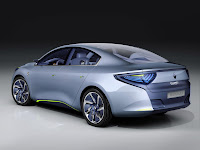
The Fluence Z.E. Concept is Renault's vision of an all-electric family car for the next future. The exterior is characterized by high-tech graphic elements, while the interior features flowing forms. It offers a range of 160 km and previews a production model.
The range is up to 160km, and the battery can be charged using one of three methods: a standard charge (between four and eight hours), a quick charge (20 minutes) or an immediate solution (three minutes) which takes the form of the exclusive 'Quickdrop' rapid battery exchange system.
Its identity as an electric vehicle is expressed through thegraphic treatment of the cooling ducts, the fins of which are reminiscent of heat transfer surfaces, and this theme is echoed in different ways in the design of the headlights and motor cover.
The photovoltaic cells located on the panoramic roof, dashboard and rear parcel shelf form a geometric grid pattern which has been carried over to the grille and seat upholstery.
Styling cues share with Renault's 'family' of electric vehicles include the Atmosphere Blue body colour, the specific luminous blue signature which features in the curved lower part of the body sides; the use of LEDs at the front and rear; the design of its headlights, - the recess behind the logo on the hood.
The headlights convey the same impression of softness suggested by the vehicle's overall lines and colour.
The centre console incorporates two floating armrests and forms a fluid, rearward-flowing arc. At the front, the integrated central front armrest includes the stop/start button, the air-conditioning and volume controls, as well as the new touchscreen Samsung Jet phone.
The photovoltaic cells meet part of the car's energy requirements with a view to complementing the power supplied by the battery, - the headlights use high-performance electroluminescent diodes which deliver an excellent trade-off between efficiency and energy consumption, - the triple-zone climate control system allows occupants to achieve just the right settings for the two seats at the front and at the rear.
The air vents also feature a dynamic lighting code, with blue representing the passage of cold air and red representing warm air, - the car's aerodynamics have been meticulously honed to minimize drag, including streamlined rear-view mirrors with integrated rearward facing cameras, a completely enclosed underside incorporating a diffuser at the rear, and spiral-form wheel rims, - Fluence Z.E. Concept runs on low rolling resistance Michelin tyres.

(Car Body Design's news)

Thursday, September 3, 2009

Renault Fluence

At the 2009 Frankfurt Motor Show Renault will unveil the new sedan variant of the Mégane model, named Fluence. The 4.6 meter long four-door car will be focused on comfort and efficiency and will go on sale in November 2009.
The range of engines includes two gasline units (6 16V 110hp, with automatic transmission or manual gearbox - 2.0 16V ) and five variants of the 1.5 dCi diesel.
Renault Fluence goes on sale from November. An electric version could be launched in 2011.


(Car Body Design's news)